
From man-hours to market position: introducing FaolanIQ
Every number a board needs starts as an hour someone spent on a project. FaolanIQ follows it all the way up.
Every project business sells the same thing. Engineering hours. Architecture hours. Estimating, planning and controls hours. Whatever the contract calls it, the unit of value is time spent by skilled people on a piece of work.
Most firms measure those hours carefully at the bottom and lose sight of them on the way up. Time sits in one system. Cost sits in another. The contract lives in a drawer until someone needs it for a claim. Risk is a spreadsheet updated the week before the board meets. The market read, if there is one, arrives as a consultant's deck.
The result is a gap between what the business does every day and what the board decides every quarter. Nobody can trace an hour booked on Monday to the margin in the management accounts, let alone to the strategic position the company should take next year.
FaolanIQ is built to close that gap.
Five layers, one line of sight
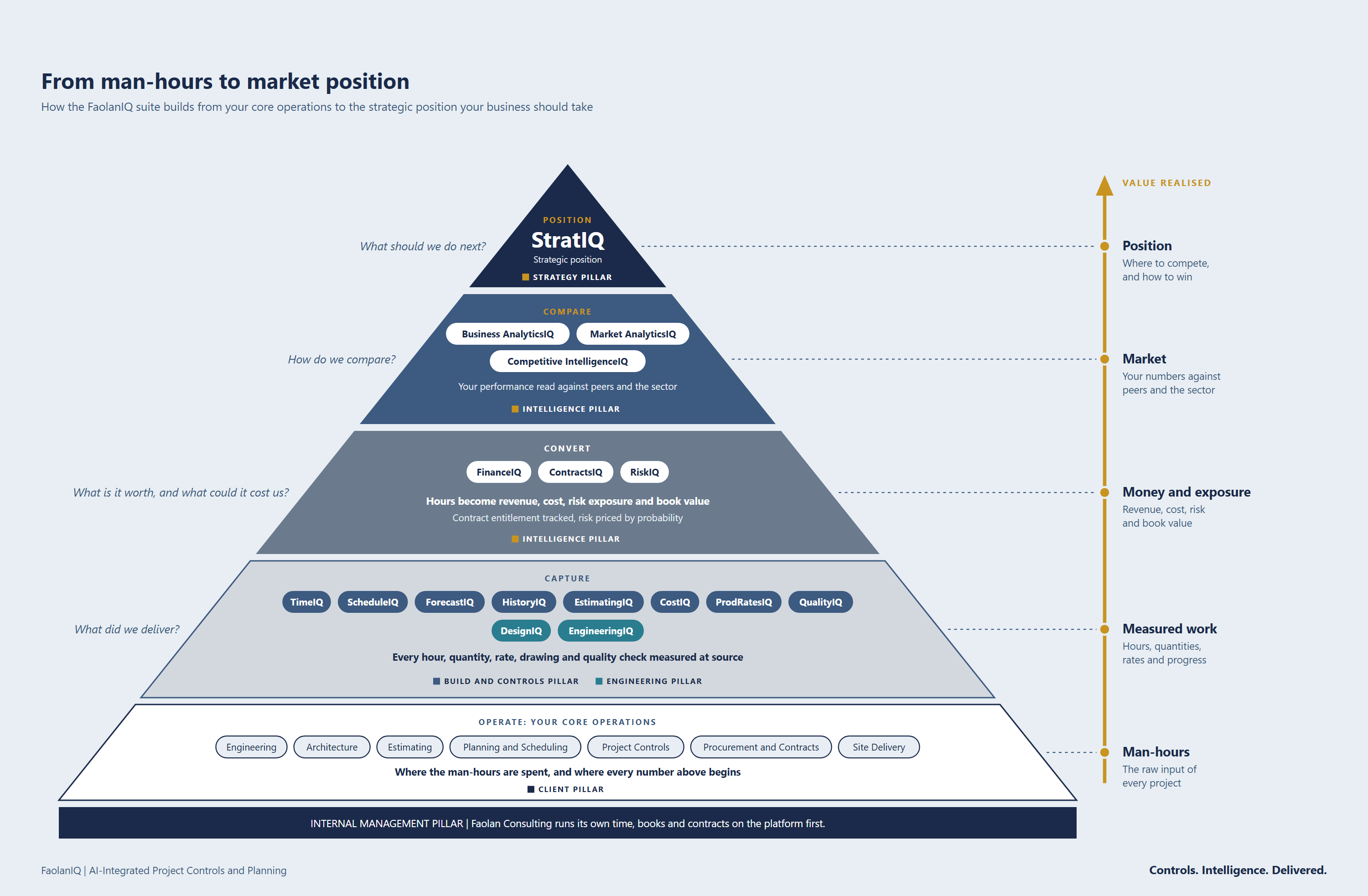
The graphic above is how FaolanIQ thinks about it. Read it from the bottom.
1. Operate: your core operations. Engineering, architecture, estimating, planning and scheduling, project controls, procurement and contracts, site delivery. This is where the man-hours are spent, and where every number above begins. FaolanIQ does not replace these disciplines. It works alongside the people who run them.
2. Capture: what did we actually deliver? TimeIQ records time where it is worked. ScheduleIQ, ForecastIQ and HistoryIQ read the programme forward, present and past. EstimatingIQ, CostIQ and ProdRatesIQ turn quantities and production rates into cost. QualityIQ tracks quality. DesignIQ and EngineeringIQ bring the design disciplines into the same data. The question at this layer is simple: what did we deliver, at what rate, for how many hours?
3. Convert: what is it worth, and what could it cost us? FinanceIQ, ContractsIQ and RiskIQ convert measured work into the four numbers a finance director cares about: revenue earned, cost incurred, risk carried and book value. ContractsIQ is built to keep the contract live, with every notice period and time bar on the register from day one. RiskIQ puts a probability on cost and schedule outcomes instead of a single hopeful date.
4. Compare: how do we compare? A number means little until it is set against something. Business AnalyticsIQ reads performance across the business. Market AnalyticsIQ reads the sector and the wider economic picture. Competitive IntelligenceIQ benchmarks you against your peers. This is where your own data meets the market.
5. Position: what should we do next? StratIQ sits at the apex. It is a board-ready strategic diagnostic: balanced scorecard, financial ratios, competitive strength, industry structure, governance, and an executive synthesis that carries the recommendation. Every module states its scoring rule before it states the score, so the board argues about the business, not the arithmetic.
Why the order matters
A strategy built from the top down rests on assumptions. A strategy built from the bottom up rests on evidence.
When the apex is fed by the layers beneath it, a strategic recommendation can be traced back through book value, risk and cost to the hours your people actually worked. That traceability is the product. A board that can see the working trusts the answer. A board that cannot see the working ends up arguing about the analyst.
Six pillars behind the suite
FaolanIQ delivers the suite through six pillars, each with a clear owner and a review gate before anything reaches a client:
- Client: your teams, your projects and your operating reality. The base everything stands on.
- Build and Controls: time, schedule, estimating, cost, production rates and quality.
- Engineering: the design and engineering disciplines, joined to the controls data rather than sitting beside it.
- Intelligence: finance, contracts, risk, and the analytics that read you against the market.
- Strategy: the diagnostic and the recommendation at the apex.
- Internal Management: Faolan Consulting runs its own time, books and contracts on the platform first, so each product is tried on a real business before it is released to clients.
Who stands behind it
FaolanIQ (Pty) Ltd is a standalone company, and it holds the FaolanIQ products. It grew out of Faolan Consulting's project controls and planning engagements across mining, energy and infrastructure, where we needed faster and more reproducible answers than spreadsheets and slide decks could give us. Faolan Consulting remains a project controls and planning house, and FaolanIQ's first and most demanding client.
What clients get out of it
Benefit realisation is where most technology stories go vague, so here it is plainly.
- Hours that reconcile. Time booked, work progressed and cost incurred tell the same story, or the difference is flagged while it can still be fixed.
- Notices on time. ContractsIQ is built to put every time bar on the register from day one, so the dates that decide a claim are in view while there is still time to act.
- Risk with a number on it. Contingency is sized from probability, not from habit.
- Book value you can defend. Work in progress and margin rest on measured delivery, not on month-end estimates.
- Strategy you can trace. The board recommendation shows its working, all the way down.
Start at the base
Our practical advice is to start at the base, not the apex. Pick one pillar and one project. Prove the hours reconcile. Then build up. Every layer you add makes the one above it more trustworthy.
The modules release in stages. Some are in use today and others are still in build, so ask us which are available now. Over the coming weeks this series walks through the suite one layer at a time, with worked case studies. If you would rather not wait, the full picture is at faolaniq.com.
Start the conversation: Mark Ransom, mark@faolaniq.com, +27 82 457 1508.
FaolanIQ (Pty) Ltd. AI-Integrated Project Controls and Planning.
Controls. Intelligence. Delivered.